Notepad Templates for KDP: The Smart Publisher’s Shortcut to Professional Low-Content Interiors
Imagine clicking “upload” on a new Amazon KDP listing and knowing the interior is already perfectly formatted, crystal clear, and ready to sell. For thousands of self-publishers, this is no longer a dream — it is the everyday reality of working with ready-made Notepad interior templates. These digital assets have quietly become one of the most efficient tools in the low-content publishing world, helping creators launch notebooks, journals, and planners faster than ever before while maintaining a polished, high-end look that customers trust.
But what exactly are these templates, and why do so many beginners and seasoned professionals alike rely on them? In this article, we dig deep into the practical value of Notepad interior designs for KDP, exploring how they work, who they serve best, and what to look for when choosing the right pack for your publishing goals. Along the way, we will walk through a real example of a comprehensive template bundle — one that includes 100 ready-to-upload interiors, multiple source file formats, and thoughtful extras — so you can see exactly what makes a template collection genuinely useful.
What Are KDP Notepad Interiors — and Why Do They Matter?
At its core, a Notepad interior for KDP is a pre-designed page layout (or set of layouts) meant to be uploaded directly as the “book interior” of a print-on-demand notebook, journal, diary, or similar item. Instead of designing every line, margin, and pattern from scratch, publishers can take these ready-made files, optionally add their own branding or tweaks, and have a sellable product in minutes. This is especially powerful in the low-content segment, where hundreds of variations of the same basic product can exist — a dot grid notebook, a daily planner, a gratitude journal, a calligraphy practice pad — each needing a distinct, clean interior.
The “Notepad” label often refers to a product type that mimics a classic top-bound or side-bound paper pad, but in practice, the templates span everything from lined paper to intricate planner spreads. The standout feature is that they ship in formats that respect KDP’s strict trim, bleed, and resolution requirements, sparing you the frustration of rejected uploads or misaligned prints. When you purchase a well-crafted template pack, you are essentially buying a shortcut through the technical learning curve.
Inside a High-Value Notepad Template Pack: A Detailed Example
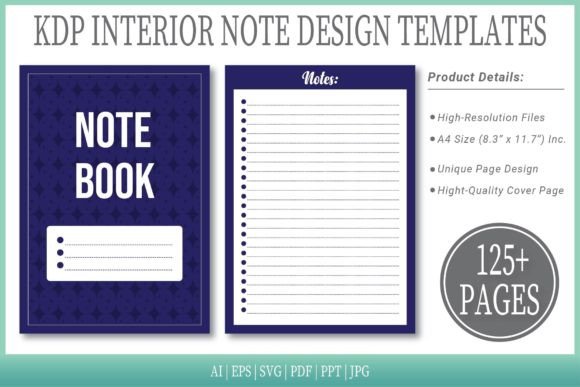
To understand the full scope of what modern Notepad templates can offer, let’s examine a typical premium collection — the kind used by publishers who want flexibility without sacrificing speed. One such bundle arrives with 100 distinct interior designs, giving you a creative library large enough to populate multiple product lines. Every file is optimized for high-resolution printing, so even the finest lines and subtle dot patterns come out crisp in the final printed book.
Here are the key specifications you would find inside this particular Notepad template download:
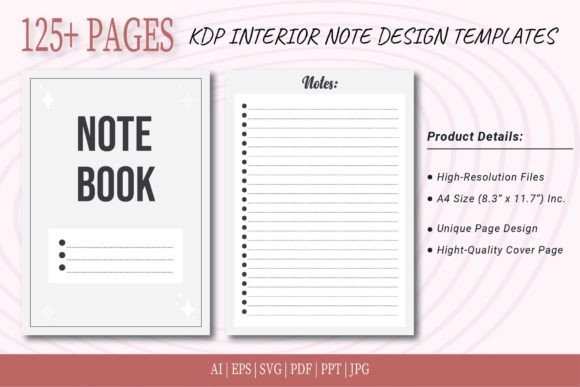
- 100 ready-for-upload files explicitly configured for Amazon KDP’s specifications.
- A4 dimensions (8.3″ x 11.7″), one of the most popular and versatile trim sizes for notebooks.
- No bleed design, which means you don’t have to worry about artwork extending beyond the trim edge — making the files truly “drop-in” ready.
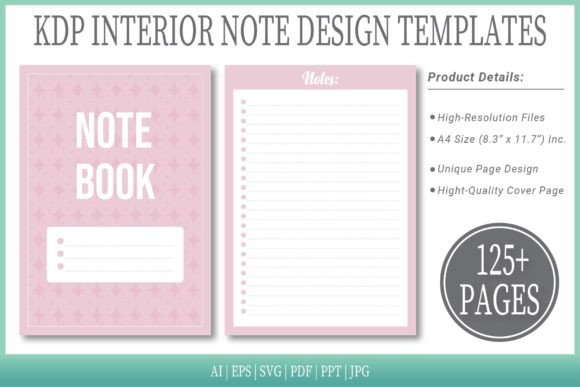
- 125 pages per interior, a sweet spot for creating substantial yet cost-effective print products that feel valuable to the end user.
- Editable source files delivered in AI (Adobe Illustrator) and EPS formats, allowing deep customization even for complex design changes.
- Additional flexible formats: SVG, PDF, PPT, and JPG. The PDF version is ready for direct KDP upload; JPGs are perfect for mockups and marketing; PPT is unexpectedly useful for quick text overlays; and SVG retains crisp vectors for scaling.
- An extra cover page included, so you can instantly pair a matching exterior with each interior — a massive time-saver for creating a cohesive product listing.
This kind of format diversity ensures that no matter your preferred editing software or skill level, there is an accessible entry point. The presence of PowerPoint as an editor, for example, lowers the barrier even further: you can add a simple company logo or header text without ever launching a complex vector program.
Additionally, many designers who create these templates release new collections consistently, so it’s wise to follow their profiles if you want to stay notified of fresh designs. Subscribing often gives you a first look at daily additions, helping you keep your publishing pipeline full without constantly hunting for new interiors.
Where Can You Use Notepad Templates Most Effectively?
Versatility is the secret strength of Notepad interiors. While they are explicitly built for Amazon KDP, the same files can power an entire print-on-demand presence across multiple platforms. Here are some real-world scenarios where these templates shine:
- Amazon KDP notebooks and journals. The most direct use — upload the PDF, set your pricing, and you’re live. The no-bleed A4 format is accepted without issues.
- Etsy printable products. With the JPG or PDF versions, you can list digital download items for customers who want to print at home. Teachers, coaches, and freelancers sell planners year-round.
- Client work and branding kits. Graphic designers can take the editable AI or EPS files, apply corporate branding, and deliver custom notebooks to business clients much faster than starting from a blank artboard.
- Bridal, baby shower, or event stationery sets. Repurpose the templates into activity pads, guest books, or keepsake journals by adding simple themed elements via the PPT or AI files.
- Educational materials. A simple grid or lined layout can become a handwriting practice book, a math exercise pad, or a music notation journal with minimal tweaks.
The common thread is efficiency. Instead of spending hours worrying about margins, safe zones, and pixel-perfect repeats, you can focus on the creative or business strategy that actually moves the needle.
Who Benefits Most from Notepad Interiors?
You might assume these templates are only for complete beginners who don’t yet know their way around InDesign. While beginners certainly gain a huge leap forward, the real audience is much broader.
- First-time KDP authors who want to avoid formatting errors that lead to account warnings or returns. A pre-tested interior is a safety net.
- Experienced low-content publishers scaling up their catalog. When you aim to publish dozens of variations each month, time is literally money. Having a library of 100 clean designs that you can remix speeds up the process exponentially.
- Coaches, consultants, and course creators who use physical journals as a branding tool or as a client-facing resource. With editable formats, they can inject their methodology directly into the interior.
- Stationery shop owners who want to expand into online sales without hiring a dedicated production artist. The PPT and PDF options feel familiar to anyone comfortable with office software.
- Side-hustlers and print-on-demand explorers who are testing the waters. A ready-made template minimizes initial investment while giving them a professional-looking product to gauge demand.
Strengths, Considerations, and What to Expect in Practice
No tool is perfect for every situation, and it’s important to walk into a template purchase with realistic expectations. The strengths are clear: tremendous speed, technical reliability, and the freedom to edit when needed. The package described earlier — with its A4 no-bleed layout, multiple file types, and included cover — addresses the most common pain points publishers face. You don’t need to understand bleed vs. trim; it’s already solved. You don’t need to recreate 125 identical pages; they’re already built.
However, thoughtful publishers also consider a few important points:
- Originality and market saturation. If you upload a template as-is, exactly as it comes, there may be other sellers using the same layout. To stand out, you should ideally customize pages, add unique elements, or combine multiple templates from the pack into a new hybrid.
- Licensing terms. Always verify the usage rights. Most template packs for KDP come with a standard license that allows you to sell printed books but may restrict reselling the digital files themselves. Respecting these terms protects your business and the creator’s work.
- Required software. While PDF and JPG are universally accessible, making the most of AI or EPS files will require vector editing software. If you only plan to use the PDF as-is, confirm that the PDF quality meets your expectations — though the high-resolution guarantee in a well-made pack largely eliminates this worry.
- Page count customization. A fixed 125-page interior is great, but if your product concept needs only 50 pages or aims for 200, you’ll need to either edit the file or accept the given count. Some publishers simply duplicate or remove pages in a PDF editor, which is a viable workaround.
These are not dealbreakers — rather, they underscore the value of choosing a template set that offers editable source files. Having the AI, EPS, and even PPT versions in the pack ensures you are never stuck with a design you can’t personalize. The extra cover page further demonstrates an understanding of the publisher’s real workflow: you aren’t just buying pages; you’re buying a ready-to-launch product skeleton.
Evaluating a Notepad Template Collection for Your Needs
With so many Notepad interior packs available online, how do you decide which one is right for your next project? Start by asking yourself a few practical questions:
- What trim size are my target customers expecting? A4 works beautifully for notebooks aimed at international audiences and is a safe default, but if you primarily sell to U.S. buyers, you might also want a letter-size option. This particular pack focuses on A4, which aligns well with a broad market.
- Do I need to edit the designs, or am I happy uploading as-is? If editing is part of your plan, prioritize bundles with AI, EPS, or SVG files. If you just want to list quickly, a high-quality PDF is sufficient — but having the extra formats future-proofs your investment.
- What complexity does my niche demand? A simple dot grid or lined notepad is almost universal. But if you operate in a highly specific niche — say, real estate planners or IBS food journals — you’ll likely need to layer additional prompts or tables. The PPT format can be surprisingly useful here for adding text boxes without design software.
- Am I building a series? If you plan to release a collection of related notebooks under a single brand, buying a large pack (like one with 100 interiors) lets you maintain visual consistency across the line while reducing your per-template cost dramatically.
- Does the pack include a cover? Pairing a cover that matches the interior’s vibe can be as time-consuming as the interior itself. An extra cover page included in the download is not just a nice touch — it’s a functional asset that can be adapted for multiple products.
Take time to preview the template designs if the seller offers sample images. Look for clean alignment, evenly spaced lines or dots, and type that renders clearly. Since the files are high-resolution, you should be able to zoom in on a preview JPG and see precise pixel-sharp edges — a sign that your printed products will look professionally crafted rather than amateurish.
Real-World Workflow: From Template to Published Paperback
Let’s paint a concrete picture. Sarah runs a small wellness brand and wants to publish a daily mindfulness journal. She purchases a Notepad template bundle that includes 100 A4 interiors, all no-bleed, in AI, EPS, SVG, PDF, PPT, and JPG formats. She browses through the collection, locates a minimalist lined layout that matches her brand’s calm aesthetic, and opens the PDF version to check the full flow. Satisfied, she then opens the PPT version and quickly adds her logo and a short daily gratitude prompt text at the top of each page — something that takes her ten minutes. Meanwhile, she uses the included extra cover page as a starting point, customizing the colors and title in PowerPoint as well. Within an hour, she has a fully branded interior and cover, exported them to PDF, and uploaded the final files to KDP. The product goes live the same day with zero formatting errors. That speed and low stress level is precisely why templates have become indispensable.
The Lasting Value of Investing in Your Creative Toolkit
Whether you publish one title a year or three new ones every week, the right Notepad interior resources become an engine for consistent quality. The collection described here — 100 designs, instantly usable in six file formats, perfectly sized at A4 with no bleed, and bundled with a cover page — represents the kind of thorough, publisher-first thinking that separates a time-saving asset from a simple pile of pages. Having the editable AI, EPS, SVG, PDF, PPT, and JPG options in one place means you are never handcuffed by software limitations, and the fact that designers frequently update their catalogs (subscribing to their profiles keeps you in the loop) ensures you won’t run out of fresh material for future seasons and trends.
Ultimately, the goal is not just to publish — it is to publish well, consistently, and with a sense of enjoyment rather than frustration. When the technical formatting puzzle is solved by a well-crafted Notepad template, you reclaim hours of creative energy that can be poured into marketing, customer research, or simply dreaming up your next bestselling idea. In the fast-moving world of print-on-demand, that is a genuine competitive advantage.