The Social Media Engagement Tracker KDP: A Practical Decision Guide
If you create or sell low-content books on Amazon KDP, you have probably seen a flood of interiors promising fast uploads and ready-to-print pages. The Social Media Engagement Tracker KDP is one such offering. It is a tested interior pack meant to help publishers launch a social media–themed tracker journal with minimal effort. But before you add it to your cart, it helps to understand exactly what it includes, where it excels, and where you might want to look at other options. This article takes a balanced, practical look at the product so you can decide whether it fits your publishing goals.
What Exactly Is the Social Media Engagement Tracker KDP?
In simple terms, the Social Media Engagement Tracker KDP is a digital bundle of interior pages for a printed journal or notebook. It is not a standalone app, a software platform, or an analytics dashboard. Instead, it is a set of files designed to be uploaded directly to Kindle Direct Publishing. The interior has been pre-tested on KDP for technical compliance, which saves you the step of checking margins, bleed, and overall print quality. Once you upload the files and add your own cover, you can publish a social media engagement tracker as a paperback on Amazon’s store.
The core idea is simple but useful: a person who wants to track their social media posts, likes, shares, comments, follower growth, and content ideas can use this book as a physical log. For the KDP publisher, it means a product that taps into the ongoing interest in content creation, marketing, and personal productivity.
Core Features and What’s Inside the Download
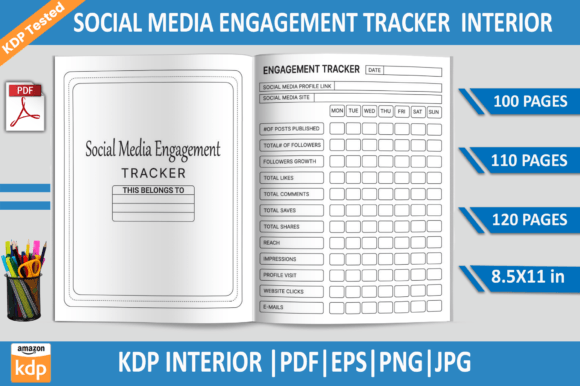
When you purchase the Social Media Engagement Tracker KDP interior, you receive multiple file formats. The seller provides three PDF variants with different page counts: 100 pages, 110 pages, and 120 pages. This range gives you flexibility. You can choose the length that matches your target price point or customer expectation. Alongside the PDFs, you get an editable EPS file, a transparent-background PNG, and a high-resolution JPG. The physical dimensions are set at 8.5 × 11 inches, a common trim size for notebooks and journals.
Other technical details matter for anyone familiar with KDP publishing. The resolution is 300 DPI, which is standard for crisp text and clean lines. The file is designed with no bleed, meaning you do not have to worry about artwork running off the edge of the page; this simplifies the upload process considerably. The listing emphasizes that the files were tested on Amazon KDP to verify quality, so you can be reasonably confident that the interior will pass KDP’s automated checks without unexpected errors.
Practical Benefits for KDP Publishers and Content Creators
The most immediate benefit is time savings. Designing a 120-page interior from scratch, formatting it to KDP specifications, and testing it yourself can take hours or days. With a pre-tested file, you can realistically go from purchase to publishing in under an hour, provided you have a cover ready. This makes the Social Media Engagement Tracker KDP attractive if you are running a volume-based KDP business or want to test a new niche without heavy upfront investment.
The inclusion of editable EPS files gives you a modest amount of customization. If you want to tweak a header, adjust a font, or add subtle branding, you can do so if you own vector editing software like Adobe Illustrator. The PNG with a transparent background is handy if you plan to create promotional images or mockups for your sales page. The multiple page counts let you experiment; some publishers find that shorter trackers sell better at a lower price, while others prefer a thicker, more premium feel.
For the end user—the person who buys and uses the physical journal—a well-structured engagement tracker can genuinely help build consistent posting habits. If the interior includes thoughtfully organized spaces for recording platforms, post types, and key metrics, the user experience is positive. That in turn reduces return rates and negative reviews. A pre-made interior does not guarantee a great layout, but a file that has been tested and sold multiple times tends to reflect some market validation.
Key Considerations Before You Buy
No product is perfect for every publisher, and there are a few points worth evaluating honestly. The first is originality. Low-content niches are crowded, and social media trackers are not new. If the interior layout looks very similar to dozens of other trackers already listed on Amazon, you may face stiff price competition. You will likely need to invest time into keyword research, category selection, and cover design that stands out. The interior alone is only one piece of the publishing puzzle.
Another consideration is the degree of creative control. While the EPS file is editable, many KDP publishers do not have the software or skills to modify vector files. If you want to add unique prompts, change the internal structure, or insert branded pages, you might find yourself limited unless you hire a designer or learn the toolset. For those who want a fully unique feel, this may feel like a constraint rather than a convenience.
Additionally, the 8.5 × 11-inch size may not be everyone’s preference. Some customers prefer more compact journals such as 6 × 9 inches, which feel easier to carry. If your target audience uses a physical logbook at a desk, a larger format works well. But for on-the-go content creators, a smaller trim size might have broader appeal. This is not a flaw, just a dimension mismatch worth noting.
When This Tracker Is a Strong Fit
The Social Media Engagement Tracker KDP works best for publishers who already know the social media niche and want a reliable, no-fuss interior to round out their catalog. If you have previously sold planners, goal-setting journals, or content calendars, adding a social media engagement tracker can be a logical extension. The pre-tested nature of the file reduces the risk of formatting rejections, which is especially valuable if you have had trouble with KDP’s interior review process in the past.
It is also a practical choice for beginners who want to go from idea to live listing quickly. Instead of getting bogged down in the technicalities of page setup and DPI requirements, you can focus on the creative side: researching keywords, designing a compelling cover, and writing a clear description. For someone with limited time or design experience, this type of product can serve as a learning tool while still generating passive income potential.
If you operate in a market where customers actively search for “social media planner,” “engagement log book,” or “content tracker journal,” having an interior that matches those search terms can help your book get discovered. The chosen keyword themes align well with small business owners, social media managers, and influencers who prefer analog tracking methods. In those communities, a well-executed tracker can build repeat customers.
Situations Where Alternatives Might Be Worth Exploring
There are clear scenarios where a different approach makes more sense. If you have strong design skills or access to an affordable designer, creating a completely custom interior gives you full control. You can tailor every page to a specific audience segment, such as Instagram-only tracking, video content metrics, or podcast promotion logs. A one-of-a-kind layout can command a higher price and generate a loyal following, whereas a widely available interior might blend into a sea of similar products.
Publishers who value exclusivity should also think carefully. Many pre-made interiors are sold to multiple buyers, which means you might end up competing with other sellers using the same exact pages. While cover design and listing optimization can still differentiate you, the interior itself does not give you a unique selling point. If standing out is a core part of your brand strategy, investing in an original design or custom template may be the better long-term move.
Another alternative is using KDP-friendly design software like Book Bolt, Tangent Templates, or Canva to build your own interior with drag-and-drop ease. These tools often come with pre-set dimensions and bleed settings. While there is still a learning curve, the result can be more personalized and adaptable across multiple niches. The time investment is higher, but the payoff in uniqueness can be significant.
Balancing Expectations with Real-World Use
It is easy to look at a product like the Social Media Engagement Tracker KDP and imagine a smooth path from download to passive income. In practice, however, the interior is only as effective as the publishing strategy surrounding it. Even a perfectly formatted file will not sell if the cover looks unprofessional, the keywords are weak, or the A+ content is absent. Treat the interior as a solid foundation, not a complete business solution.
Sales also depend on seasonal trends and current interest in social media marketing. A tracker that performs well during January goal-setting season might dip later in the year. Diversifying your catalog with complementary interiors—such as content planning notebooks or hashtag research journals—can smooth out revenue. The Social Media Engagement Tracker KDP fits nicely into a broader portfolio but rarely will it become a standalone bestseller without additional effort.
From a buyer’s perspective, the physical book they receive must deliver value. If the tracking prompts are generic or the layout feels cramped, reviews may reflect that. Although you cannot control the interior design once you purchase a pre-made template, you can choose a version with a generous page count and clear, uncluttered sections. The 120-page variant, for example, offers more room for daily tracking over several months, which may lead to higher customer satisfaction than a thinner book that expires too quickly.
Final Thoughts on Whether It Aligns with Your Goals
Deciding whether to use the Social Media Engagement Tracker KDP comes down to three questions. First, how much do you value speed and convenience over complete originality? If you want a tested, ready-to-publish interior that saves hours of formatting, this product delivers on that promise. Second, does your target audience prefer a larger-format journal? The 8.5 × 11-inch size might match your brand or your customers’ workspace habits, but if your research points toward smaller, more portable books, this interior may not be the best fit. Third, what is your plan for differentiation? A strong cover, strategic keywords, and niche-specific positioning can still set your listing apart, even with a shared interior.
There is no right or wrong answer, only a clearer understanding of what the product provides and where it falls short for your specific publishing model. The Social Media Engagement Tracker KDP interior is, at its core, a practical tool for publishers who want to move quickly and reliably into the social media logbook space. Weigh the trade-offs honestly, and you will be in a better position to decide if it belongs in your KDP toolkit.