Avoid Costly Mistakes When Using the Reading Journal - KDP Interior
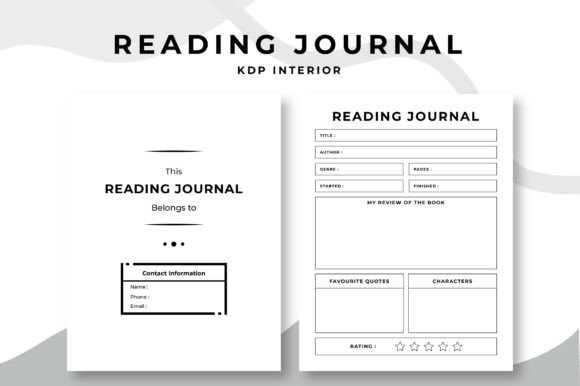
There’s a quiet thrill in holding a book journal made just for you—or better yet, one you’ve published yourself. The Reading Journal - KDP Interior package promises exactly that: a ready-to-use set of files that turns a simple idea into a polished, print-ready book for Amazon’s Kindle Direct Publishing. It arrives with multiple PDF interiors (100, 110, and 120 pages), fully editable source files in Ai and EPS, plus SVG, PNG, and high-quality JPG versions. On the surface, it’s a plug-and-play dream for book lovers, bloggers, and side-hustle creators. But that convenience can vanish quickly if you skip a few important checks—and many first-timers do. The good news? Every common slip-up is avoidable with a little insider know-how.
Understanding What You’re Actually Buying
A surprising number of people download a KDP interior and assume they can hit “publish” in an afternoon. They mistake the bundle for a finished book, when it’s really a customizable design foundation. The Reading Journal - KDP Interior provides structured pages for tracking titles, authors, ratings, quotes, and reflections. It’s meant to be a blank canvas where you can add your brand, change fonts, tweak colors, or layer seasonal themes. Ignoring this editable nature leads to a missed opportunity and a generic product that blends into a crowded marketplace. Before you list anything, take time to open the Ai or EPS file and make it unmistakably yours. Even small customizations—like a unique header or a curated “recommended reads” section at the back—signal quality to buyers and help your version stand out.
The Overlooked Danger of "Resizable" Files
One of the first things buyers notice is the promise: “6 x 9 inches, can be resized.” That’s technically true—the vector source files allow transformation—but resizing without understanding aspect ratios and bleed requirements is the fastest way to ruin a journal’s layout. A common mistake is stretching a 6×9 design to 8×10 or A5 without reworking the internal grid. The result? Margins that suddenly look lopsided, text boxes that cut off, or decorative elements that bleed unpredictably. If you plan to offer multiple trim sizes, start from the editable Ai or EPS file, not from a flattened PDF or PNG. Use the proper canvas size for each new format, then manually adjust or realign every element. Yes, it takes more time, but it’s the difference between a professional product and a rushed one that invites returns.
Resolution Myths That Can Sabotage Print Quality
The package includes 300 DPI assets, and that number often gives a false sense of security. 300 DPI at the original 6×9 inches is excellent, but if you enlarge a raster element—say, a background texture from the JPG or PNG file—you’re lowering the effective resolution. Many creators grab a pretty PNG overlay and scale it up for a full-bleed cover or an interior background, then wonder why the print proof looks fuzzy. The fix is simple: always use vector elements (from the Ai, EPS, or SVG files) for anything that needs resizing. Keep raster images for fixed-size details, and if you must scale a pixel-based asset, never go beyond 15–20% enlargement. When in doubt, zoom into your design at 400% and check for soft edges before uploading to KDP.
Why Page Count Flexibility Can Backfire
Having three PDF interiors—100, 110, and 120 pages—feels generous, but it’s an underappreciated pitfall if you don’t plan your final book structure first. Some sellers grab the 120-page file thinking “more is better,” then realize their content only fills 80 pages and the extra sheets create a perception of emptiness. Others pick the 100-page option and later want to add seasonal reading challenges without the room to do so. Inconsistent page counts across formats can also confuse customers if you sell on multiple platforms and one version suddenly has a different thickness. Map out your content beforehand. If your reading journal includes daily spreads for half a year, monthly summaries, and dotted note pages, calculate the total. Then pick the nearest PDF base and either trim excess pages (using the editable source) or add a few custom spreads. That way, every page feels intentional.
File Format Confusion and the “Print Ready” Assumption
“Print Ready” is a term that gets thrown around casually. The PDF interiors in this bundle usually come prepared for KDP, but that doesn’t mean every single PDF variant is upload-ready right out of the zip. Sometimes margins are slightly off for particular printer settings, or the file includes a colored background that violates KDP’s ink coverage limits. A person once uploaded the standard PDF without checking, only to get a dreaded email from Amazon Support about transparency and flattened layers. Another overlooked the fact that the included PNG and JPG files are not print-ready for interior pages at all—they’re supplementary assets for marketing or low-volume use. Always use the PDF for your final upload, and open it in Adobe Acrobat or a similar tool to inspect bleed, trim lines, and overall appearance. Ignoring this step can lead to rejected proofs and missed launch dates.
The Hidden Value of Editable Source Files
Some buyers treat the Ai and EPS files as scary, “designer-only” bonuses and never touch them. That’s a missed strategic advantage. When you rely solely on the static PDF, even a simple desire to change the header font or shift a star-rating symbol becomes a cumbersome workaround. The editable vector files let you align the journal perfectly with your personal or business brand—swap in your logo, use your signature color palette, or adapt the layout for niche audiences like fantasy readers or academic researchers. You don’t need to be a graphic design pro; free tools like Inkscape (for SVG) or affordable ones like Affinity Designer can open these formats. Invest an hour learning the basics, and you gain full creative control instead of being locked into someone else’s template. When you do pass the file to a professional designer later, they’ll thank you for providing a clean source they can work with quickly.
How Overlooking Amazon’s Content Guidelines Tarnishes a Good Product
Even the most beautifully customized reading journal can get suspended if the interior doesn’t meet Amazon’s minimum quality standards. A recurring mistake is using the JPG cover file inside the interior pages for “decoration” without checking resolution and color space. Amazon expects interiors to be in CMYK, while the provided JPGs might be in RGB—a mismatch that can shift colors dramatically when printed. Another slip-up: low-contrast text. A journal page with pale gray prompts on a soft cream background might be a great aesthetic on your screen, but on a press, it can become illegible. Before you finalize, convert the entire file to CMYK, double-check that all text meets contrast guidelines, and ensure no critical elements sit in the gutter (the inner margin that disappears into the binding). These small technical verifications keep your listing healthy and your star ratings from tanking over “blurry” or “unreadable” reviews.
Building a Book That Feels Worth Returning To
A reading journal isn’t just a stack of pages; it’s a companion for someone’s literary life. One of the most common usability oversights is failing to balance structure with freedom. You’ll see journals that demand a rating, a quote, a synopsis, and three reflections for every entry—leaving no room for the reader’s own rhythm. Then there are journals that swing too bare, offering dated lines but nothing to prompt deeper engagement. The Reading Journal - KDP Interior template gives you a solid foundation: space for title, author, start/finish dates, notes, and ratings. Use this as a launchpad, not a prison. If you’re customizing, consider adding gentle, optional sections—like a “mood when reading” icon or a “what did this book teach you” line—that invite reflection without demanding it. Ask yourself: would you actually enjoy filling this out day after day? If the answer is a maybe, make tweaks until it’s a confident yes. That thoughtfulness translates directly into better reviews and repeat buyers.
What to Check Before You Hit “Publish”
When the editing is done and excitement bubbles, it’s tempting to rush the final export. Instead, create a quick checklist to catch the mistakes that often slip through:
- Trim size and margins: Confirm the PDF is exactly your chosen trim size and that interior margins accommodate binding without swallowing text.
- Image links and fonts: If you used editable source files, ensure all linked images are embedded and fonts are outlined to avoid missing characters on Amazon’s end.
- Color profile: Convert to CMYK and preview the result. Some vectors with vibrant RGB blues turn muddy—adjust before it’s too late.
- Page numbering and consistency: Flip through the entire file. Are the headers aligned? Did a stray text box sneak outside the safe zone? Do odd and even pages mirror correctly on spreads?
- Test on paper: Print a few sample spreads at home or at a local shop using the “actual size” setting. You’ll notice alignment quirks and contrast issues that screens hide.
Taking an extra thirty minutes for these checks can prevent returns, negative reviews, and the frustration of re-uploading files multiple times.
When the Template Isn’t Enough—And That’s Okay
Sometimes a creator realizes midway that the provided layout, while solid, doesn’t fully match a specific vision—like a joint reading journal for couples or a children’s book tracker with illustrated icons. There’s no shame in recognizing the need for more. The Reading Journal - KDP Interior shines as a starting point, not an end-all. From here, you can purchase additional matching page elements on marketplaces, hire a designer to expand on the vector source files, or combine two interiors into a fresh hybrid. The key is to avoid forcing a square peg into a round hole. If the template’s rating system won’t fit your “buddy read” concept, build a new spread using the same style elements from the Ai file to maintain visual continuity. Buyers appreciate coherency, and a journal that serves a specific community often outperforms a generic “one size fits all” version.
Final Practical Thoughts
The Reading Journal - KDP Interior isn’t magic—it’s a well-structured toolkit that rewards attention to detail. When you treat it as raw material to refine rather than a finished book to slap a cover on, the payoff is tangible: happier readers, smoother publishing, and a product that genuinely helps someone organize their reading life. Remember that the little things—an adjusted margin here, a clarified prompt there—accumulate into a reputation for quality. Stay curious, test every change, and never assume a file is print-ready just because it’s been used before. Your future self, holding that first author copy and flipping through crisp, intentional pages, will be glad you took the time.