Travel Log Book KDP Interior: A Ready-Made Publishing Kit
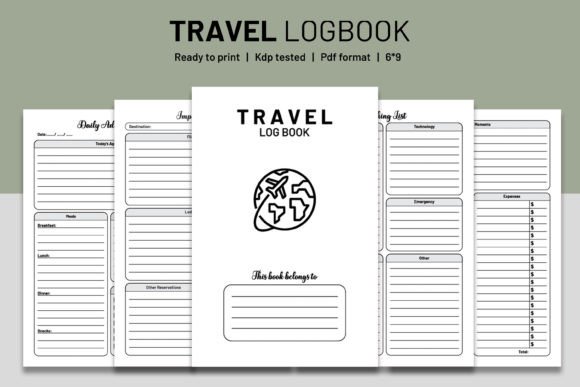
Creating a travel journal that looks professional, prints flawlessly, and meets Amazon KDP’s technical requirements can feel daunting—especially if you’re starting from a blank screen. A Travel Log Book KDP Interior solves that problem by giving you a complete, pre-designed file set that’s already been tested for success on Kindle Direct Publishing. It’s not just a template; it’s a thoughtfully laid-out 120-page interior that includes an intro page, clean master pages, and full bleed setup in a popular 6×9-inch trim size. Whether you publish one title or build an entire line of low-content notebooks, having a ready-to-upload interior lets you skip the formatting guesswork and focus on what matters: getting your book in front of readers and travelers.
What makes this particular interior stand out is the mix of file formats. You get an editable AI file for deep customization, a high-resolution PDF for immediate press-ready output, and PNG files that give you granular control over individual elements. That combination means you don’t have to be an Adobe Illustrator expert to publish a polished book, but you also aren’t locked out of making meaningful changes if you do have design skills. The dimensions are fixed at 6×9 inches, a size that feels comfortable in a backpack or suitcase, and the 120-page count offers enough room for multiple trips without becoming bulky. Because the interior is designed with bleed and has been tested on KDP’s platform, you can upload it, order a proof copy, and feel confident that margins, gutters, and trim lines will behave exactly as expected.
Why Different Creators Value This Interior Differently
Not everyone approaches a Travel Log Book KDP Interior with the same goals. A hobbyist who wants to publish a single travel diary for personal use or as a gift will care most about speed and simplicity. They don’t want to learn about bleeds, safe zones, or resolution requirements—they just want to upload a file and see a real book arrive in the mail. For them, the high-resolution PDF is the star of the show. It’s a one-click solution that turns an idea into a physical product without any technical detours.
A freelance graphic designer or publishing professional, on the other hand, may see the same file set as a starting point rather than a finished product. They’ll open the editable AI file and tweak fonts, add subtle branding, adjust line spacing, or swap out the intro page for something that matches a client’s visual identity. The fact that the interior is already KDP-tested saves them hours of troubleshooting. They can focus on creative enhancements instead of re-measuring margins and double-checking PDF/X standards. For them, the value lies in flexibility and the confidence that the technical foundation is rock-solid.
Travel bloggers, coaches, and content creators often view this interior as a brand extension tool. A travel coach might use the template to create a reflective “Trip Debrief” journal that complements their online course or webinar series. A blogger could brand the intro page with their logo, add a QR code linking to their website, and sell the book as merchandise to their community. The 6×9-inch size is easy to ship and fits well on a shelf next to other travel gear. Because the master pages are already well spaced and the bleed is set, adding a subtle branded footer or a repeating pattern in the background becomes a low-risk upgrade rather than a layout puzzle.
Small stationery businesses and Etsy sellers often need speed and repeatability. They might publish multiple themed travel journals—road trip edition, solo female travel, family vacation, camping log—by swapping the intro page and cover while keeping the interior consistent. The PNG files are particularly useful here because they can be opened in nearly any basic editing software, even free tools, to make small tweaks. The interior’s 120-page structure works well for both weekend getaways (with plenty of space for notes) and longer journeys (where travelers can log daily highlights across several trips).
Educators and workshop facilitators sometimes use a log book interior in unexpected ways. A geography teacher could adapt the pages as a field trip journal for students, with the intro page serving as a permission slip or itinerary. A wilderness guide might print a limited batch for clients on multi-day hikes. In these cases, the heavy lifting of layout is already complete; the educator only needs to customize the cover and perhaps a few internal prompts. The KDP-ready format means they can order author copies at a low cost, which matters when budgets are tight and proofing must be hassle-free.
What Makes a “Good” KDP Interior from a User’s Perspective
If you’ve ever tried to format a book interior from scratch, you know that the hidden details eat up the most time. A Travel Log Book KDP Interior that’s been KDP tested and comes with bleed already included solves the issues that normally trip people up: images that shift after trimming, text too close to the edges, inconsistent page numbering, or a PDF rejection because of non-embedded fonts. The fact that this particular interior arrives as an editable AI file along with a finished PDF means it prioritizes both reliability and room to grow. That balance matters because a template that’s too rigid frustrates creative users, while one that’s too complex overwhelms beginners. Providing both high-resolution PNGs and a print PDF bridges the gap between “I just need it to work” and “I need to make it mine.”
For people who care most about speed and getting to market quickly, the ready-to-upload PDF and the KDP-tested guarantee are the main draws. They don’t have to wonder if something will go wrong during the review process. For those who prioritize presentation and uniqueness, the AI file is the key. It allows them to adapt column layouts, add custom prompts like “Daily Distance Hiked” or “Local Foods Tried,” and still maintain the structural integrity of a book that prints correctly. Quality-wise, high-resolution files mean the lines and any subtle decorative elements stay crisp when printed, which is especially important for a journal that someone will hold, write in, and treasure.
Cost sensitivity also influences how people evaluate these interiors. Hiring a layout designer for a 120-page book could cost hundreds of dollars. For a small publisher testing a new niche, buying a pre-made interior dramatically lowers the financial risk. If the book doesn’t sell well, they haven’t sunk significant cash into custom formatting. If it takes off, they can always circle back and invest in a fully bespoke design later. The editable AI file even allows them to evolve the interior without starting over.
Matching Your Own Goals to This Travel Log Book Interior
Before you decide whether this interior fits your project, ask yourself a few practical questions. Are you comfortable with the 6×9-inch trim size? It’s a standard for journals, but if you envisioned a pocket-sized log or a large-format scrapbook, you’ll need to check whether the provided files can be scaled or if you should look for a different size. The 120-page count is generous for a trip log, but if you want a hyper-minimalist 50-page booklet, you’ll need to edit the AI file to remove pages. Since the interior is fully editable, that’s possible; it just requires some time and the right software. The presence of an intro page is a nice touch because it gives you a natural spot to place a personalized message, table of contents, or quick travel tips before the log pages begin.
If you’re new to KDP and feel nervous about the technical side, look for the two things that matter most: the PDF file and the phrase “KDP tested.” Those tell you that someone has already walked the path, uploaded the file, ordered a proof, and confirmed that the margins aren’t cut off. The additional PNG files and AI source file are a bonus you can grow into later. Even if you never open the AI file, you benefit from knowing it’s there if your publishing ambitions change. Beginners often find that starting with a working interior builds momentum; once they see a printed proof, they gain the confidence to experiment with future titles. That psychological boost shouldn’t be understated.
Experienced publishers might scan through this offer looking for the bleed specification and whether the interior is truly print-ready or requires pre-flight checks. The fact that the listing mentions “with bleed” and “ready to upload” indicates the designer understood KDP’s trim and margin requirements. You can still run it through KDP’s previewer or a desktop pre-flight tool for your own peace of mind, but you shouldn’t need to rebuild anything from scratch. The editable AI file means you can export fresh PDFs with different settings if your printing needs evolve—for example, if you decide to use a different print service that requires a slightly different bleed value or color profile.
For content creators and marketers, alignment with your brand voice matters. Since you can modify the intro page and, through the AI file, even adjust internal headings or footer text, you can inject personality without touching the page structure. A classic travel log might have simple date, location, and notes fields, but you could add a “Mood” rating or “Best Meal of the Day” prompt to differentiate your book in a crowded travel journal category. This kind of small customization helps your book feel authored rather than generic, which can lead to better reviews and repeat customers who enjoy your particular take on a travel diary.
Practical Ways Different Users Put the Interior to Work
Consider a part-time traveler who wants to document her road trips and share printed books with family. She uses the PDF as-is, uploads it to KDP, and orders a handful of author copies. No editing, no stress. Her book arrives within days, and the layout looks clean and inviting. Her relative, a freelance designer, sees the book and decides to create a similar log for his hiking club. He opens the AI file, swaps the intro page text, adds a subtle topographical pattern in the background of each log page, and exports a new PDF. He then sells the tructured log through his own KDP account. The same core interior supported two very different outcomes: one zero-edit, one customized.
Now picture a travel agent who wants to offer a branded travel log as a client gift. She doesn’t want to become a publisher; she simply needs a quality notebook with her agency’s logo and contact details. She uses the PDF for the interior, leaves the master pages untouched, and works with a separate cover designer to create a wrap that matches her brand. She can order bulk author copies during KDP’s occasional promotions, keeping her costs per unit low while delivering a polished, memorable gift that clients actually use. The interior’s high-resolution output ensures her logo on the intro page looks sharp, which reflects well on her business.
A school geography club might use the interior to create an expedition journal for a student trip. The teacher removes a few pages to reduce the page count (and print cost), adds the school’s emblem on the intro page, and prints through KDP. The fact that the file is print-ready saves the teacher from a lengthy battle with word processors or slide software that aren’t built for book layout. The students receive a professional-looking logbook that elevates the whole experience.
Long-Term Usefulness and Adaptability
Beyond publishing a single title, a well-structured Travel Log Book KDP Interior gains value over time as you reuse it. Because the AI file is fully editable, you can create seasonal variations—summer, winter, cultural immersion, volunteer travel—without re-buying a new template for each. You can also translate the intro page or prompts into other languages to reach international markets, still operating from the same foundational design. The PNG files let you pull individual page elements into online tools like Canva if you ever want to create matching digital downloads or printables for a different platform. This cross-use flexibility is especially helpful for entrepreneurs who want to repurpose content across Etsy, Gumroad, and their own websites while maintaining a consistent look.
As your skills grow, the presence of a professional source file can also serve as a learning resource. You can study how the bleeds were set, how the master pages were arranged, and how fonts were embedded to better understand book design principles. That knowledge transfers to your own future projects, whether you ever buy another template or decide to build your own from scratch. In that sense, the interior is both a practical shortcut and a quiet educational tool.
Is This the Right Interior for Your Project?
Ultimately, a Travel Log Book KDP Interior that offers editable AI, high-resolution PDF, and PNG files in a KDP-tested 6×9-inch format with bleed checks several boxes for a wide range of users. If you value speed and simplicity, you can use the PDF immediately. If design flexibility and brand differentiation are your priorities, the AI file gives you room to play. If you aim to create multiple products with minimal recurring costs, the interior can become a reusable asset. The key is understanding where you sit on the spectrum between “just publish it” and “make it fully mine,” and then using the file format that matches that intention. Because all three formats are included, you don’t have to choose just one path; you can start simply and explore more customization as your comfort level or business needs evolve.